AI writing tools are a normal part of content work now, and plenty of teams use them to rough out a first draft fast. That's fine. But some readers and buyers are wary of AI, so it's fair to ask why AI generated content should be reviewed by a person if it already reads well. The short answer is that a named person has to stand behind every page you publish. Here's the longer one.
Two surveys on AI content and the people who read it
Two recent surveys help explain that wariness, one from the people who make content and one from the people who read it. We've linked both, so you can read them in full.
On 30 September 2026, Ahrefs published its second yearly survey of marketers on AI and content. Of the marketers who answered, 93% use AI to create or help create content. Among those AI users, 7% said "more than 75% of the content they publish is pure AI, without any editing or additional input", up from 4% in 2025. (Ahrefs (https://ahrefs.com/blog/marketers-ai-content-creation/))
So the group publishing unedited AI content is still small, and it's growing. The same survey found 66% of marketers trust AI written content only if a person reviews it first. Keep in mind these are self reported answers from one survey.
And on the reading side, Auros published a study on 16 October 2026. Talker Research ran it for Auros, surveying 4,000 adults in the US, UK and Australia between 26 August and 1 September 2026. It found that "48% of Brits, 45% of Australians and 44% of Americans said they go out of their way to do business with brands that do not use AI in their advertising". (Auros (https://auros.ai/newsroom/ai-shopping-survey-2026))
That figure is about advertising, so read it as a signal for ads in particular. Still, it tells you plenty of people notice AI in marketing, and some act on it.
Readers notice unchecked pages
Those survey answers match a feeling you've probably had on a thin page. It reads smoothly and goes on for a while, yet you reach the end with your question still open. Or it states a claim with total confidence, and the claim fails a quick check.
Readers can pick up on that, whether or not they guess a tool wrote it. The page feels unattended, and from there they may begin doubting the rest of your site.
A person reading before you publish catches the obvious problems.
- facts that are wrong or out of date
- claims you'd struggle to back up
- advice meant for a different kind of customer
- the same point made three times in different words
- a tone that sounds unlike you
Customers blame the brand for a page's mistakes
And those problems come back to you. If a page quotes the wrong price, or promises a service you've dropped, the customer will blame your brand.
It's even more serious in areas like money and health. We wrote about this in our posts on writing for fintech and writing for health tech. In both, a person on your side has to check every claim and agree to it before it goes out.
So "sign off" means a named person has checked the page and is happy to put the company's name to it.
Here's the kind of edit a careful read makes.
Unchecked draft
Our cutting edge solutions get results for every business, every time.
Reviewed and signed off
We write care guides for houseplant shops. Each guide names the plant, the light it needs and how often to water it.
The first line promises big results and leaves the proof out. The second makes a plain claim a reader can check for themselves. (Both lines are made up example copy for a made up studio.)
Google's advice on AI content and review
Search gives you one more reason to review. Back in February 2023, Google's post on AI generated content (https://developers.google.com/search/blog/2023/02/google-search-and-ai-content) said its systems reward high quality content however it's produced, and that appropriate use of AI falls within its guidelines. Its current guidance on using generative AI content (https://developers.google.com/search/docs/fundamentals/using-gen-ai-content) adds a warning. Using AI to churn out lots of pages without adding value for readers can break its spam policy on scaled content abuse.
On 1 October 2026 Google updated that help doc, and Search Engine Roundtable reported the change the same day (https://www.seroundtable.com/google-updates-ai-content-guidelines-factcheck-review-42217.html). The page now says generative models "predict a likely sequence of words based on their training data" and that outputs "may contain inaccuracies (also known as hallucinations)". Then comes the key line. "It is critical to manually factcheck and review all AI-generated content for accuracy and trustworthiness before publishing." Google says that review also covers titles, meta descriptions, structured data and image alt text.
So a review helps with search too. It's where a person asks whether the page helps a reader, and fixes the page before it goes up.
Where AI helps, and where a person still has to finish the job
To be fair, AI tools can be handy. They can suggest an outline or offer a few headline ideas when you're stuck. And Ahrefs found 85% of the marketers in its survey who use AI say they're producing content faster since adopting it. That speed is useful, as long as a person still checks the draft.
Your team carries the context a tool lacks. They know the product and its prices, and they know which customer emailed last week with a question the page should answer. They can also flag a claim that might cause trouble with a regulator. That context is how a draft becomes a page people trust.
So if you use AI, use it for the first rough pass. Then hand the draft to a person who knows the business, and give them time to do the job properly. A rushed review defeats the point.
The cost of publishing AI drafts unchecked
Skip that handoff and the bill arrives later. Small errors build up across a site, and a run of sloppy posts can make the whole site feel careless. Fixing them later usually takes longer than checking them the first time.
There's a second cost, too. Readers who think your content is churned out begin to doubt the pages they lean on most, like your pricing and your contact page.
How to review an AI draft in four checks
So what does a careful review actually involve? The process can stay small. You need a person who knows the subject and your customers, and a little time for four checks.
- Is every fact true? Check each fact, figure and quote against a source you can link to, and cut any claim you can't source. 2. Does the page sound like your brand? Our post on brand voice has more on this. 3. Does the page help your customer? It should answer the question they came with. 4. Is the writing clear? Keep the sentences short and cut the filler.
Then name one person to sign off. The page goes out when they say yes, and it waits in draft until then.
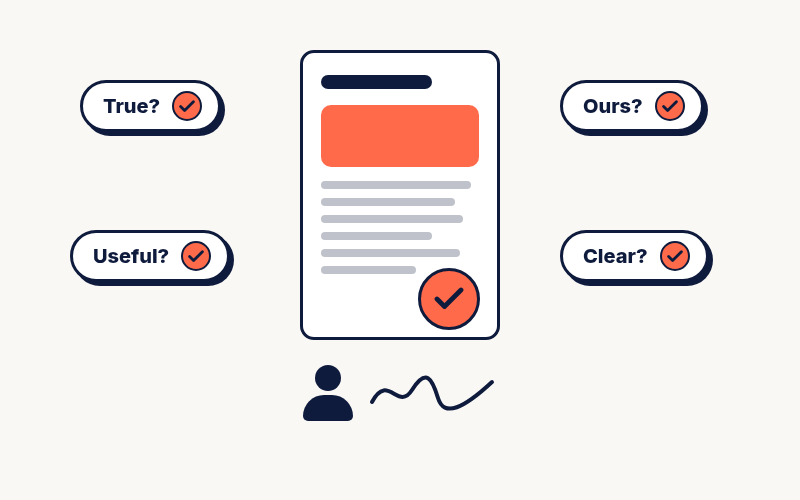
Run the four checks in order, and save the sign off for the end.
A simple sign off rule for AI content
Put those checks together and you have a rule that's easy to keep. Whoever writes the first draft, a tool or a person, a named person on your team should check and sign off on every page before it goes live. If you publish for clients, they should see the final version and say yes too.
That takes longer than hitting publish on a first draft. It's worth the time, because readers notice the difference.
Human review of AI content FAQ
Before you set up your own review, here are quick answers to a few common questions.
Why should AI generated content be reviewed?
Tools can state wrong facts and repeat themselves, and they can drift away from your brand's voice. A person catches those problems before readers do, and readers judge your business by the page.
Does Google penalise AI content?
Appropriate use of AI is fine under Google's guidelines, according to its 2023 post on AI content. Its current guidance says mass producing pages that add little value can break its spam policies. And since October 2026 that guidance calls it critical to manually factcheck and review AI generated content before publishing.
Do customers mind if brands use AI?
Some do, at least in ads. In the Auros study, 44% to 48% of adults in each of the three countries said they go out of their way to do business with brands that keep AI out of their advertising.
Who should sign off on a blog post?
Pick one named person who knows the subject and the customer. In regulated areas like finance or health, that may need to be an expert too.
Want a second pair of eyes on your pages?
And if that review is hard to staff, we can help. Send us a page that went up fast. Have a look at our services, or email hello@markazer.com with a link to the page you'd like a careful second read on, and we'll send back a few honest thoughts.