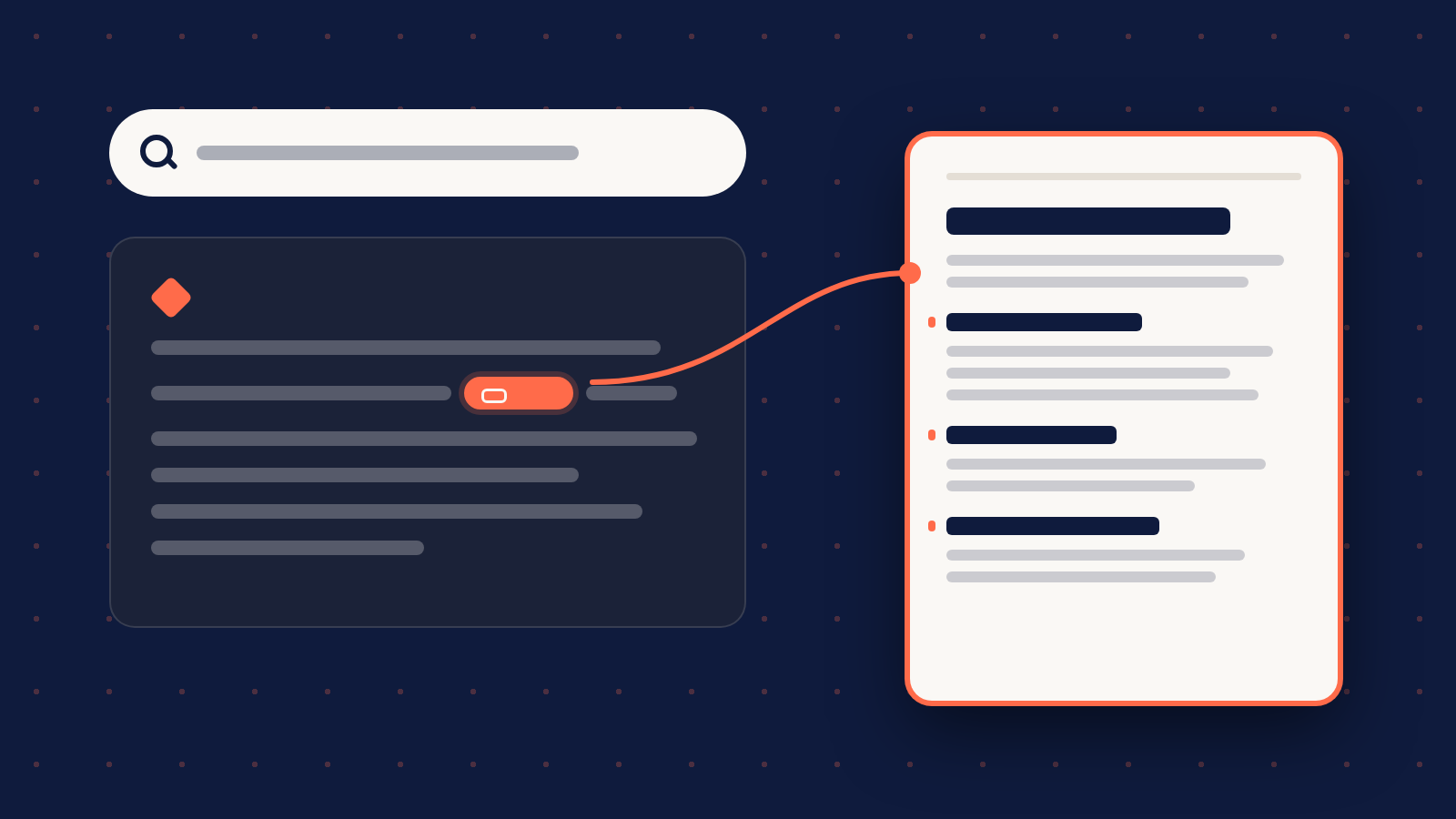
Search Google for a how to guide or a product comparison today and there's a good chance you'll see an AI written answer at the top, with links tucked inside it. If you run a website, you've probably wondered how your pages end up as one of those links. This guide walks through how to write content for AI search, using Google's own advice and two fresh studies on the brands AI answers name.
How Google explains AI Overviews and AI Mode
So where do those answers come from? Google runs two AI features in Search, and they behave a little differently.
AI Overviews are the short AI answers at the top of some results pages. Google says they give people the gist of a complicated topic quickly, with links to explore further. But plenty of searches go without one. Google only shows an AI Overview when its systems decide it adds to the classic results.
AI Mode is a more chatty way to search. You can ask longer questions and compare options, and Google answers with links to supporting sites.
Both features can run several related searches behind the scenes to build one answer. Google says that's why they can link to a wider spread of sites than a classic results page.
Google's October 2026 update adds more links to AI answers
And in October, Google gave those answers more links. On 15 October 2026 it announced updates to AI Mode and AI Overviews (https://blog.google/products-and-platforms/products/search/updates-ai-mode-overviews-explore-web/) to help people click through to websites. In plain terms the update brings
- more links inside the answer text, placed higher up in the answer
- a test of a section at the top that points to official sites for some tasks, with a note on why each link is useful
- carousels of timely articles in more countries and languages
- clickable creator and publisher names on video results in AI Mode, which Google is still testing
So a page has more chances to be linked than before. The harder part is writing a page worth one of those links.
Google says normal SEO basics apply to AI search
You'd expect a new rulebook to come with all those links. But Google's own guide, AI features and your website (https://developers.google.com/search/docs/appearance/ai-features), says the usual SEO best practices already cover AI Overviews and AI Mode. So you can leave AI text files and special schema off your list. To be shown as a link, a page has to be indexed and eligible to appear in Google with a snippet. That's the same bar normal search sets.
Google also lists a few basics worth checking.
- let Google crawl your pages
- link to your important pages from other pages on your site
- give people a good experience on the page
- put important content in text, backed by good images and video where they help
- make sure any structured data matches the visible text on the page
Writing for AI search, then, is mostly writing well for search and for people.
How to write content for AI search
That leaves the writing itself, which is the part you control. These habits line up with Google's advice on helpful, reliable content made for people.
Answer the question early and plainly
First, put the answer near the top. If your page is about how long a content audit takes, give the answer in a sentence or two and then explain. Readers like that, and it makes your page an easy one to point to.
Here's one opening written two ways.
Before
Content audits are an increasingly vital part of a holistic marketing strategy, and many factors can play a role in how long one takes.
After
A content audit for a small site usually takes a few days. This guide walks through each step in order, from the first page list to the final report.
The second version answers the question in its first line. (The timing is example copy, so put in your own.)
Write headings that name the topic below them
Your headings can carry that plain style down the rest of the page. "How much does a content audit cost?" tells a reader far more than "Investment" does. Plain headings help people skim, and they make each part of the page easy to find. So try writing each heading as a question a reader might type.
Cover the follow up questions
But one answer rarely ends a search. Google says AI Mode suits longer questions and comparisons, and that both features can run related searches to build an answer. So think about the next question your reader will ask. A reader learning about content audits will probably want to know the cost next, and how long one takes. A short FAQ at the end is a simple way to answer those.
Be the source people trust
And then there's trust. Google's guide points back to its usual advice on helpful, reliable content made for people. In practice that means you
- write from your own knowledge and experience
- show who wrote the page and who's behind the site
- link to sources for any facts and figures
- keep pages up to date, and fix or remove old ones
The last point is where a content audit helps.
Make the page easy to understand
All of that rests on a reader being able to follow you. Keep your sentences short and give each paragraph one idea. If you're in a technical field, explain your topic the way you would to a smart friend. Our guide to explaining your AI product in plain English has more on this.
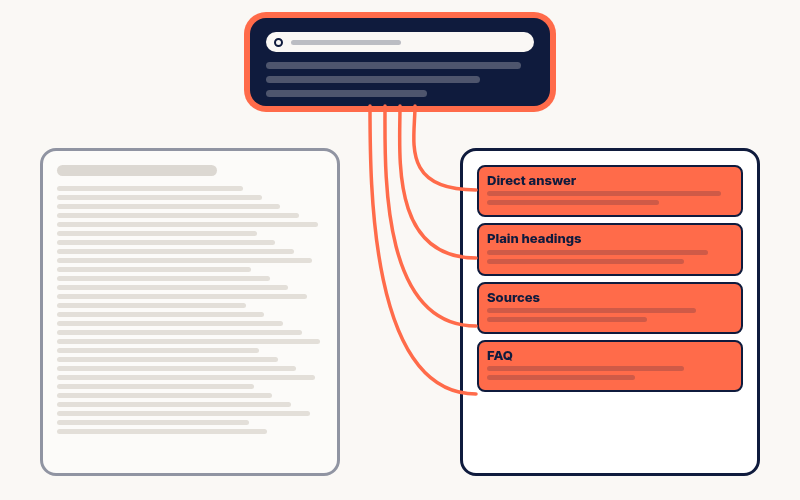 AI Overviews and AI Mode link to pages that meet the same basics as normal Google Search.
Why brand names in AI answers are hard to catch up on
Clear pages help you earn a link. But AI answers also name brands in their text, and two studies from early November 2026 suggest the brands named early are hard to dislodge.
On 2 November 2026, AirOps published The cost of waiting in AI search (https://www.airops.com/report/the-cost-of-waiting-in-ai-search). It tracked answers on ChatGPT, Gemini and Google AI Mode from January to September 2026. On the same questions, brands first named in an answer in Q3 2026 appeared in 3.6% of that question's answers, while brands already named in Q1 and Q2 appeared in 36.7%, about 10x as often. AirOps puts the ratio at about 1 to 10 on each engine. The report covers unbranded buyer questions, pooled across brands, with the three engines weighted equally. AirOps also admits the topic is close to home, since its business is helping brands invest in AI search. So treat it as one study, and leave room for other tools to find a different pattern.
A day later, on 3 November 2026, Ahrefs published Which Types of Mentions Correlate the Strongest With AI Visibility? (https://ahrefs.com/blog/mention-types-ai-visibility/). It compared seven types of mention on other sites for 10,000 US brands. Then it checked how often those brands appear in AI Overviews, AI Mode and ChatGPT, across 260 million prompts that left the brand name out. Reddit mentions in threads that rank in Google had the strongest Spearman correlation, about 0.75. Webpage mentions and domain mentions came next at 0.70, with news article mentions at 0.67. Ahrefs sums it up as "Reddit is the strongest signal with a ~0.75 correlation on the Spearman scale." But the post is careful to call these correlations, and Ahrefs writes that it "can't say for certain that more mentions cause more AI visibility." In the sample, a brand with 10x more Reddit mentions tended to have about 5.5x more AI mentions. The median brand had 8 Reddit threads naming it, and 29% had none.
Taken together, the two studies point the same way. Being talked about where AI systems already read, especially in Reddit threads that rank in Google, tracks closely with being named in the answer. Ahrefs also warns that a visible lift probably takes a large, steady rise in the number of sites talking about you, tracked over months. So write clearly now, and notice where your brand already comes up.
How to see if visitors are coming from AI search
So how do you know if any of this is paying off? Google says visits from AI Overviews and AI Mode count toward your normal Search Console Performance report, under the "Web" search type. That means the numbers you already track include them. Google also suggests tools like Google Analytics for conversions and time spent on your site, so keep an eye on those too.
How to write content for AI search FAQ
That covers the main steps. Here are a few quick answers before you begin.
Does a page need special markup or an AI text file to appear in AI Overviews?
Google says the usual technical requirements for Search are enough. A page has to be indexed and eligible to show with a snippet, and you can skip AI text files and special schema.
Is writing for AI search different from SEO?
Mostly it's the same job. Google says the usual SEO best practices still apply to AI Overviews and AI Mode. The extra focus goes on clear answers near the top and plain headings, plus answers to the follow up questions.
Why do AI Overviews appear on some searches and skip others?
It comes down to Google's systems. Google says an AI Overview appears when its systems decide it adds to the classic results, so many searches show the classic results alone.
How do I know if AI search is sending me visitors?
Open the Performance report in Search Console. Google counts traffic from AI features under the "Web" search type there.
Want a hand making your pages clearer?
And if you'd like a second pair of eyes on a page, we'd be glad to take a look. We help teams write pages that answer their customers' questions in plain words, for people first and search second. Have a look at our services, or email hello@markazer.com with a page you'd like us to read. We'll send back a few thoughts or a clear quote.