 Google judges the page that reaches the reader, whoever or whichever tool wrote the first draft.
If you've typed "does Google penalize AI content" into a search bar this year, Google's own answer is short. It rewards helpful content however it's produced, and its spam policies go after pages made mainly to game rankings. The detail sits across a few pages of Google's documentation, so this guide walks through them in plain English, for owners and marketing teams who use AI in their writing and want to know where the line is.
What does Google actually say about AI content?
The clearest statement is still Google's blog post on AI generated content (https://developers.google.com/search/blog/2023/02/google-search-and-ai-content), from February 2023. Its FAQ answers the question directly.
"Appropriate use of AI or automation is not against our guidelines."
The same post says Google's ranking systems aim to reward original, high quality content, and that Google judges the quality of a page, whichever way it was produced. Asked whether AI content will rank highly, Google replies that "Using AI doesn't give content any special gains."
Google's current guidance on generative AI, last updated on 1 October 2026, keeps that line. It says generative AI "can be particularly useful when researching a topic, and to add structure to original content". So the tool itself is fine in Google's eyes, and the result is judged on the same terms as a page written by hand.
So which AI content breaks the spam policies?
That same guidance page carries a warning, and it points to a policy called scaled content abuse. Google's spam policies (https://developers.google.com/search/docs/essentials/spam-policies) describe it as "when many pages are generated for the primary purpose of manipulating search rankings and not helping users". The policy adds that this applies however the content is made, so a team of people churning out thin pages would fall under it too.
The examples Google lists include using AI tools to generate many pages without adding value for users, and stitching together content from different web pages without adding value. The pattern in each one is volume with little new for the reader.
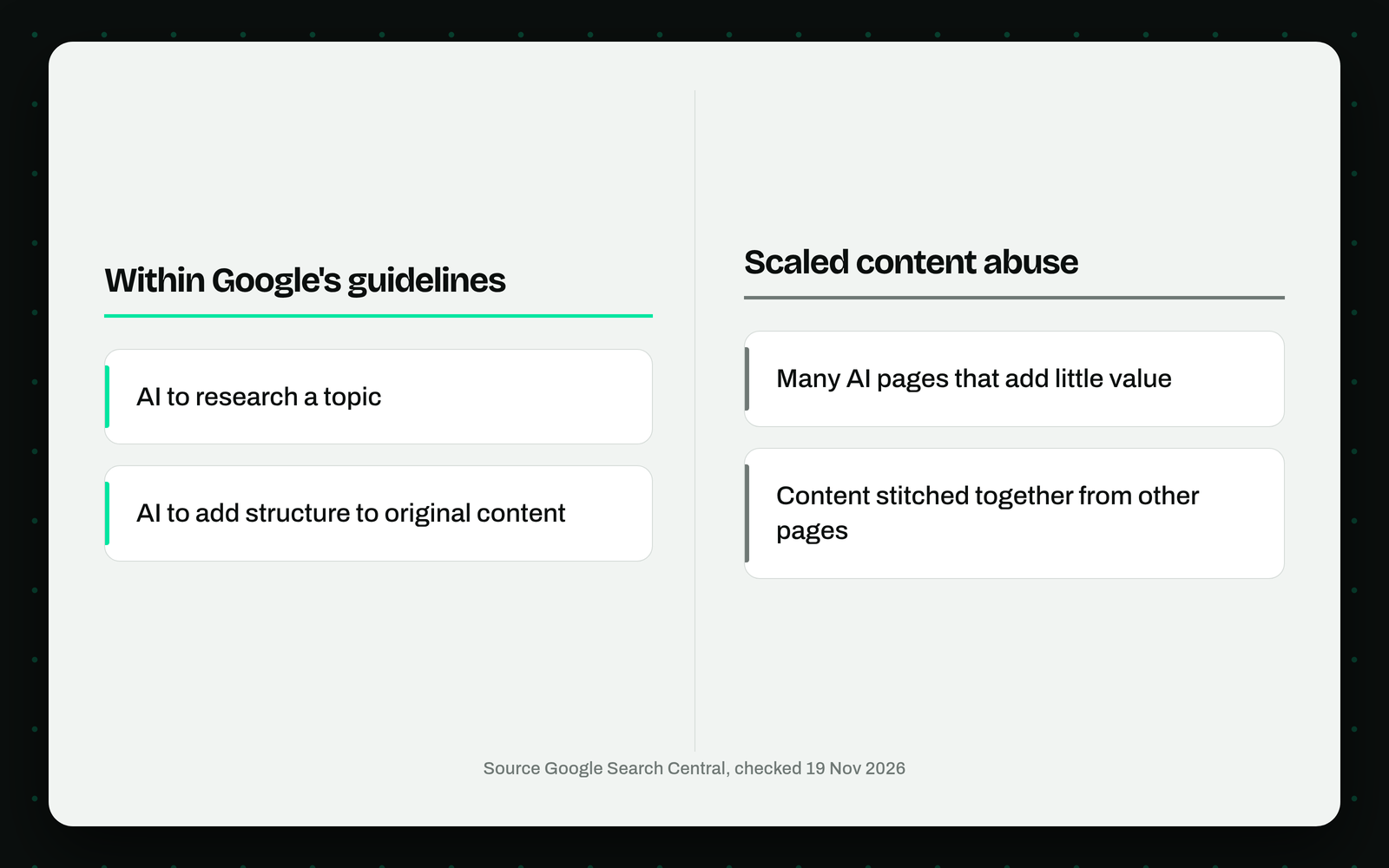 Google's own examples show where AI use crosses into spam, and every one of them involves pages made in bulk for rankings.
Where do brands come unstuck?
Those policies sound abstract until you see the shortcuts behind them. One is a page for every city or region with near identical text, which Google's doorway abuse policy covers. Its examples include "pages targeted at specific regions or cities that funnel users to one page". AI makes those pages quick to produce, which is exactly why the shortcut tempts people.
Facts are the other weak spot. Google's guidance points out that generative models predict a likely sequence of words, and it warns that their outputs may contain inaccuracies, which it calls hallucinations. A made up figure or a product feature you don't offer lands on your brand, and the reader has no way of knowing a tool wrote it.
Google's checklist for helpful content adds a few warning signs. Among them are using extensive automation to produce content on many topics, and mainly summarising other sources without adding much value.
What happens if Google decides a page is spam?
With those risks in mind, it helps to know the consequences. Google's spam policies say it detects violations through automated systems and, where needed, human review that can lead to a manual action. Sites that break the policies "may rank lower in results or not appear in results at all".
A manual action is visible to you. Google notifies site owners in the Manual actions report and the Search Console message center, and you can fix the issue and ask for a review. A drop in traffic during a core update is a separate thing. Google released its November 2026 core update on 10 November, and its guide to core updates says these changes are broad in nature and "don't target specific sites or individual web pages". A dip during an update says little about AI on its own.
Why does a human edit still count?
That leaves the part a person adds. Google's generative AI guidance says it is critical to fact check and review AI generated content for accuracy before publishing, and that the review covers page titles, meta descriptions, structured data and image alt text too, since those can appear in search results.
The edit also adds the parts a model can't supply, such as your own experience with customers and the details of the service you sell. Google sums up those qualities as experience, expertise, authoritativeness and trustworthiness. We've written more about why a person should still sign off on AI generated content.
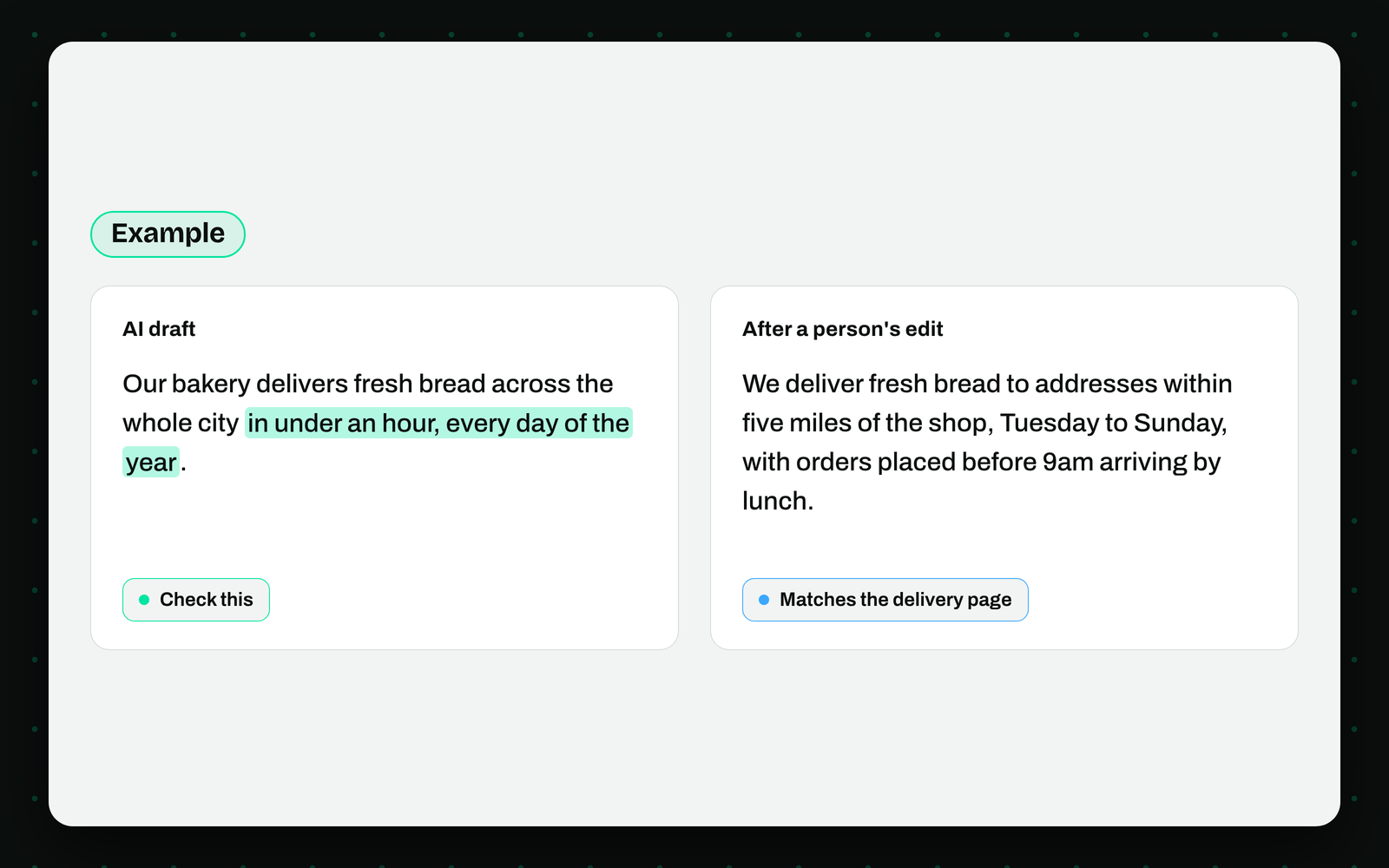 An illustrative example of one paragraph before and after a person's edit, with the unchecked claim replaced by a sourced detail.
Google also suggests thinking about who made a page, how, and why. Where a reader might reasonably wonder how a page was created, it says an AI or automation disclosure can help, and it calls an AI author byline "probably not the best way" to make that clear.
FAQ
Can Google detect AI content?
Google's public guidance talks about spam, and leaves AI detection aside. Its 2023 post says its systems, including one called SpamBrain, "analyze patterns and signals to help us identify spam content, however it is produced". The safer question for a business is whether each page helps the person reading it.
Is AI content good for SEO?
AI content earns no bonus and carries no penalty for being AI. Google's words are "Using AI doesn't give content any special gains." A page ranks on how useful and trustworthy it is, and AI can help you write it faster if a person checks the result.
Does Google care about AI generated content?
Google cares about quality and about pages made to manipulate rankings. It also asks publishers to give readers context where they would expect it, such as background on how automation was used. If you want your pages to appear in AI answers as well, our guide to content that AI search picks up and links to covers that side.
Want help with AI assisted content?
If you'd like a hand with content that holds up in search, we're happy to help. At Markazer, people lead the strategy and own the results, and AI helps us deliver quickly. You can see how we help on our services page or email us at hello@markazer.com.